Google+ Blitzkreag: Bike
Showing posts with label Bike. Show all posts

Kawasaki Z1000

Kawasaki's fourth generation naked


                                                         The Z1000’s appearance has always elicited strong emotions—the look either inspires or disturbs you. For 2014, Kawasaki’s big-bore streetfighter has become even more fringe due to what Kawasaki calls a “sugomi-inspired” design. What is sugomi? It’s a Japanese word that describes the energy or aura emitted by an object of greatness, and Kawasaki says it was the philosophy that drove the Z1000’s redesign.


                                                              The 1,043cc inline-4 has been thoroughly reworked for improved midrange and top-end power. Thanks to a new intake camshaft (with 0.3mm less lift and six degrees less duration), plus a modified airbox, a revised ECU, and taller velocity stacks for improved cylinder filling, the dohc 16-valve mill pulls hard all the way to its 11,250-rpm redline and “soft” rev limiter. Furthermore, new internal passageways in the crankcase reduce high-rpm pumping losses, and overall smoothness is enhanced by a crank-driven balancer. Lastly, a pair of ducts in the Z1000’s fairing route cool intake air directly to the airbox.


                                                                       It’s cast as a single unit with the swingarm pivot to eliminate welds. The engine, a stressed member, bolts solidly to the frame in three places and is rubber-mounted at the upper rear crankcase.The lightweight three-piece design allows the Z1000 to be narrower under the seat, reducing the reach to the ground.The spring-preload adjuster works on the left tube, whereas the compression- and rebound-damping adjusters are only on the right. The main goal with this fork, says Kawasaki, is smooth initial travel for improved feel during braking. In back, a horizontal shock with stepless rebound damping and a remote preload adjuster is said to be unaffected by exhaust heat.


                                                       Although the gold calipers are badged by Kawasaki, they are made by Tokico and feature differentiated piston diameters (32mm top, 30mm lower). Kawasaki has also switched to a radial-pump front master cylinder and grippier pads, for firmer initial feel. ABS is provided by Bosch.Unusual tachometer features a bar graph that “jumps” from a vertical lower LCD screen to a horizontal row of bright LEDs across the top. It’s easy to read, with a large digital readout for speed. Previous Z1000, notably, had its gauges tucked low in a spot ahead of the top triple-clamp. New bike has the gauge panel mounted above the wide handlebar, which makes the Z1000’s signature design feature—its prominent headlight assembly featuring four LED bulbs—look like it’s mounted much lower than it actually is.


                                                           So, what’s the new Z1000 like to ride? Impressive. It’s totally at home in the city, where it can spurt in and out of traffic with ease. And it’s a delight on twisty mountain roads, where the suspension that feels a tad overly firm in the bumpy city gives the bike a welcome composure in high-speed sweepers. A wide powerband and abundant torque eliminate the need for frequent downshifts, and the gearbox is click-click second nature, blessed with an easy-to-modulate clutch.
                                                           In short, Kawasaki’s new Z1000, which retails for $11,999, is a great bike. Say what you will about its styling, but this Kawasaki is an impressive update on what already was an excellent bike. But does it have what it takes to beat newcomers such as the Yamaha FZ-09 or proven Europeans such as the Aprilia Tuono V4 R or MV Agusta Brutale 800.


View more pics at the galleria -  Kawasaki Z1000


Read more

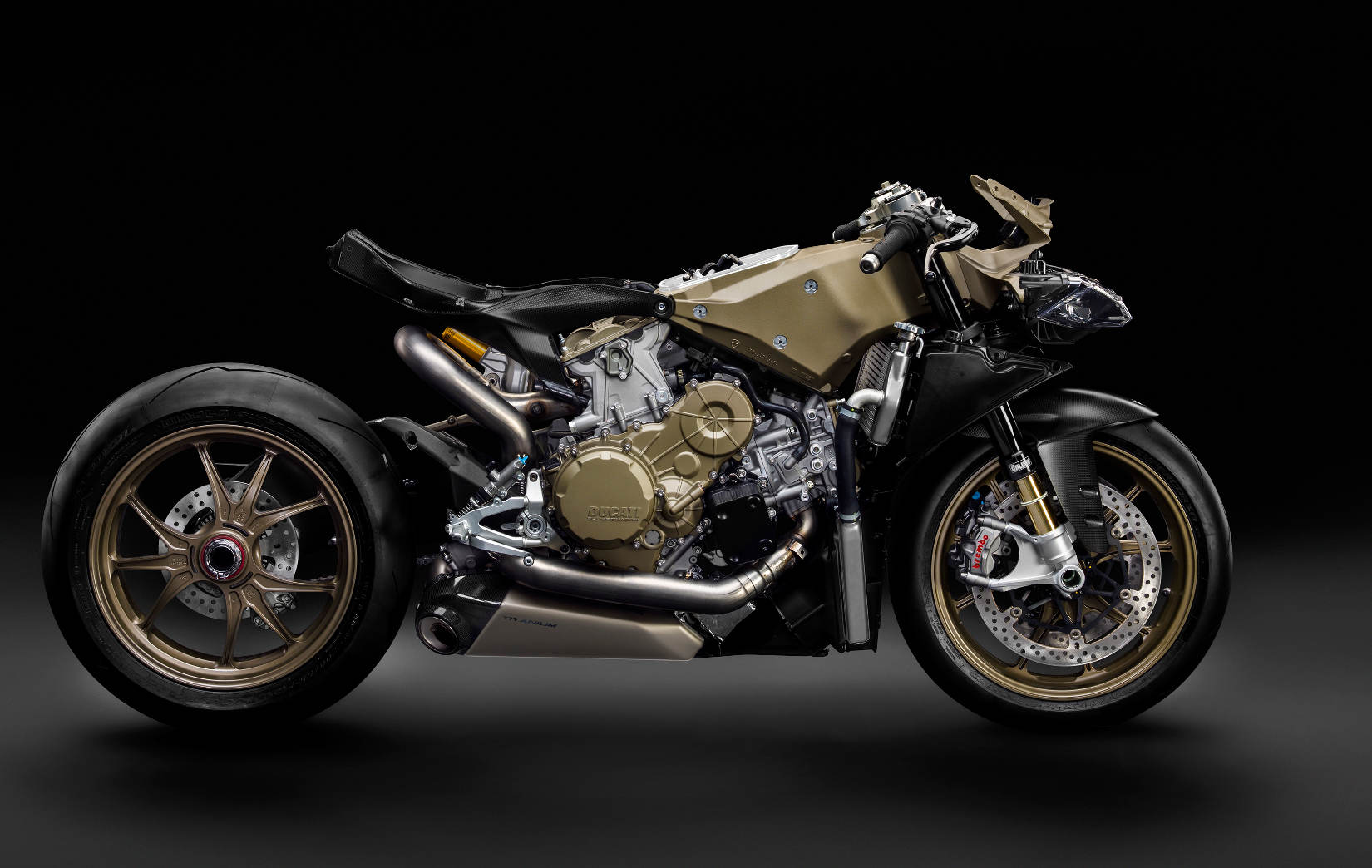
Ducati 1199 Superleggera


Ducati's most exciting superbike till date:


                                                    It was called Project 1201, the singular goal being to build the ultimate sportbike at any price. And it’s going into production now as the Ducati 1199 Superleggera.
Leggera means “light” in Italian. You figure out the rest… At a claimed 341.7 lbs. dry (390 pounds curb weight, same as the Panigale dry) the Ducati 1199 Superleggera simply is a work of mechanical art, all of its precious fallout coming from the Panigale racing experience.

The team of engineers and specialists under the guidance of new Chief Project Engineer Andrea Forni revised every single element of the machine, starting at the heart of its already extreme 1198cc V-twin. The crankshaft was significantly reduced in mass and size by completely reworking the large counterweights that now look like slim tomahawk blades decorated by small cylinders of tungsten (which is much heavier than steel) inserted at the sides to achieve the appropriate balancing mass. In this way, the crankshaft is reduced also in terms of cross section, thus decreasing the drag caused by pumping the oil vapors in the crankcase. Further weight savings in the powertrain came from the adoption of titanium valves on the exhaust side, which join the Panigle’s Ti intakes.


                                                  Titanium is used also for the complete exhaust system and most bolts used in the construction of the 1199 Superleggera. Given the outstanding elastic module of this metal, a titanium wire of adequate diameter is coiled around the Öhlins TTX36 shock in place of the traditional steel spring. Magnesium replaces aluminum just about anywhere it can, starting with the cast magnesium pyramidal structure that acts as front section of the frame and airbox. Wheels are magnesium forgings by Marchesini.

                                                       A lithium ion battery alone saves about five pounds, while carbon fiber was adopted in the construction of every body component, plus the seat-supporting substructure. Öhlins supplies its latest, ultra-light FL916 fork and Brembo its renown monobloc front calipers and MCS 19-21 radial master cylinder. A high-tensile aluminum alloy and a 520-type chain save weight in the final drive. Only 500 of these beauties will roll out of the factory.


View the galleria for more pics : Ducati 1199 superleggera
Video of Ducati Superleggera   : Ducati Superleggera Promo


ENGINE
Engine Superquadro: L-Twin cylinder, Desmodromic valve actuation, 4 valves per cylinder, liquid                                          cooled
Displacement            : 1,198 cc
Bore X stroke            :112 x 60.8 mm
Compression ratio    :13.2:1
Power                       :exceeds 200 hp (149Kw) @ 11,500 rpm
Torque                      :134 Nm (99 ft-lbs) @ 10,200 rpm
Fuel injection            : Mitsubishi electronic fuel injection system. Twin injectors per cylinder. Full                                            Ride-by-Wire elliptical throttle bodies
Exhaust                      :2-1-2 system, primary tubes in titanium. Twin titanium mufflers. 2 lambda                                             probes and 2 catalytic converters

TRANSMISSION
Gearbox                      :6 speed
Primary drive              : Straight cut gears; Ratio 1.77:1
Ratio                            :1=37/15 2=30/16 3=27/18 4=25/20 5=24/22 6=23/24
Final drive                   :Chain; Front sprocket Z=15; Rear sprocket Z=41
Clutch                          :Hydraulically controlled slipper/self-servo wet multiplate clutch with                                                     Superbike configuration

CHASSIS
Frame                            : Monocoque in magnesium alloy
Front suspension           :Fully adjustable 43mm USD Öhlins FL 916 fork with TiN treatment, billet                                             fork bottoms and lightweight stress-optimized outer tubes
Front wheel                   :3-spoke magnesium alloy 3.50" x 17"
Front tyre                      :Pirelli Diablo Supercorsa SP 120/70 ZR17
Rear suspension            :Fully adjustable single Öhlins TTX36 shock with titanium spring, with                                                     linkage adjustable between progressive/flat. Aluminium single-sided                                                       swingarm. Adjustable swingarm pivot.
Rear wheel                     :3-spoke magnesium alloy 6.00" x 17"
Rear tyre                        :Pirelli Diablo Supercorsa SP 200/55 ZR17
Wheel travel (front/rear)  :120 mm (4.7 in) - 130 mm (5.1 in)
Front brake                    :2 x 330 mm semi-floating discs, radially mounted Brembo Monobloc Evo                                              M50 4-piston callipers with ABS, Brembo MCS 19-21 adjustable-ratio front                                          brake master cylinder, remote lever adjuster
Rear brake                      :245 mm disc, 2-piston calliper with ABS
Instrumentation              : Colour TFT display

EQUIPMENT
                                          Riding Modes - Power Modes, ABS, DTC, DQS, EBC, DES, DDA+ w/GPS module, Fully RbW. DWC based on inertial platform. Dedicated buttons for rapid setting of DTC, DWC, EBC. Titanium rods. Carbon fibre parts: fairings, seat base, heel guards, air duct covers, power switch cover, rear shock cover, front and rear mudguards. Titanium bolts.
Read more

Yamaha R25


Yamaha R25


                                                Yamaha is all set to join the 250cc motorcycle segment by launching the R25  next year, to compete with the likes of CBR 250R and the baby Ninja. The Japanese manufacturer recently unveiled the M1- based R25 at the Tokyo Motor Show.

                                                The Yamaha R25 will be twin cylinder, making it a premium 250cc, compared to its Honda and Kawasaki rivals. The twin cylinder motor will be liquid-cooled and use an advance fuel injection system. The R25 borrows its styling from Yamaha’s M1 MotoGP machine, making it one of the best looking quarter-litre motorcycles.

                                                  The motorcycle uses a tubular chassis with telescopic front suspension and disc brakes at both the front and rear. ABS might be optional.


                                                  It is still not sure if Yamaha would sell the motorcycle with a twin cylinder engine or a single cylinder one. Considering Yamaha aggressive approach with R15, it would be safer to assume that the R25 will be a segment leading motorcycle, in terms of performance, competing with the likes of RC390, Ninja 300 and the Daytona 250.


                                                    Keeping our finger's crossed on this machine...


       View the galleria for more pics - Yamaha R25 galleria


Read more